Research & Ideas: Discourse &
Digital Culture
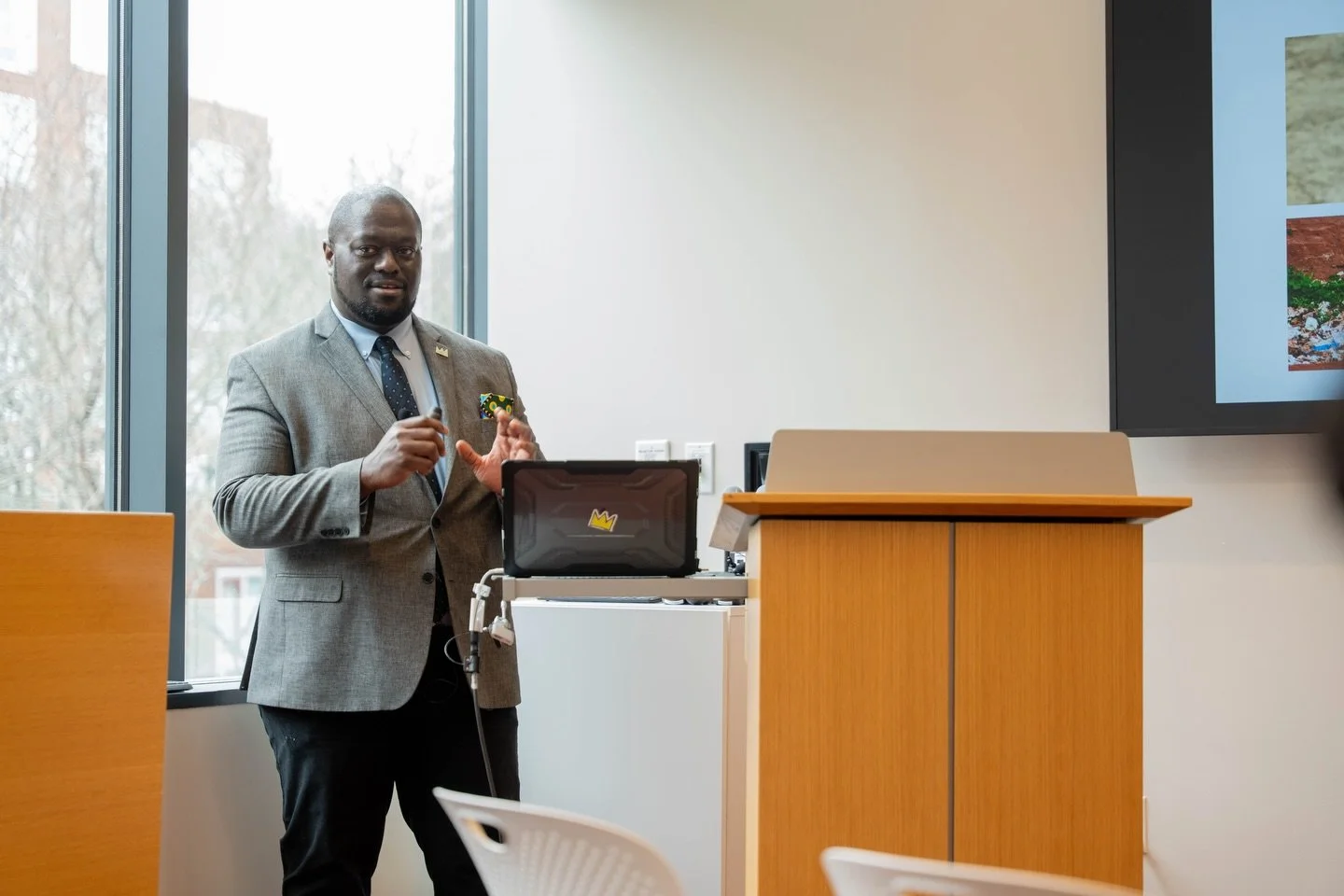
My current research examines how trust, belief, and community formation increasingly happen outside public view — especially inside private digital messaging networks (PDMNs) such as WhatsApp groups, Discord channels, Slack communities, and other trusted messaging spaces.
I study how these spaces shape what people share, what they withhold, who they believe, how narratives spread, and how institutions misunderstand communities they cannot easily observe.
This is applied research. I do not study these dynamics only to describe them; I use research to develop practical insights, policy recommendations, communication strategies, and tools that help institutions, platforms, funders, and community leaders better serve the people and communities affected by these systems.
My goals are rooted in real-world impact: expanding perception, improving decision-making, reducing harm, and creating more effective ways to build trust, opportunity, and understanding.
This work grows out of my experience as a founder, technologist, storyteller, and researcher working across immigrant communities, media, civic trust, entrepreneurship, and narrative strategy.
At the center of my work is a simple question:
What do institutions miss when they rely only on public signals to understand private belief, community trust, and human behavior?
Core Research Themes
The Quiet Majority
I assert that the majority of people’s true perspectives are not represented in public discourse due to social punishment, reputational risk, or institutional mistrust. Real perspectives are shared in closed trust spaces.
Trust Spaces
Closed or semi-private digital environments where people exchange information, test beliefs, seek interpretation, and build community away from public scrutiny amongst groups they feel kinship with.
Adaptive Community Curation
My theory which posits that culturally salient communities that are not served by a consistent and well-funded media publisher will inevitably construct their own organic, decentralized information networks.
Perception Gaps
How public narratives influence can distort who is seen as credible, modern, risky, investable, threatening, talented, or worthy of support and how that conflicts with evidence, informations and verifiable reality.
Private Digital Messaging Networks
The closed communication infrastructures which include WhatsApp groups, Discord channels, Slack communities, etc., where modern discourse and community formation increasingly happen.
Why this matters
Civic Trust &
Public Discourse
Media, Disinformation, and Misinformation
Entrepreneurship and Capital Access
Global Development & Human-Centric Storytelling
Institutional Relevance and Decision-making
The "Quiet Majority" theory posits that while public conversations are dominated by polarized extremes, most people possess complex, nuanced views they fear to share openly due to social punishment.
Consequently, these vital perspectives retreat into Private Digital Messaging Networks (PDMNs) or "trust spaces," resulting in a profound Civic Decline.
Because these transformative ideas are hidden from the public square, we lose the very insights that could bridge divides and reshape how even the most polarized voices view a topic.
Misinformation is not just a byproduct of "low literacy," but rather a fragmented media landscape that allows even the most educated individuals to insulate themselves within bias-confirming digital silos.
In these networks, cultural resonance and community trust often supersede traditional journalistic standards. This environment turns "truth" into a marker of group identity, making it harder for objective information to penetrate curated community bubbles..
Historically challenged, overlooked, or low-resource communities succeed best when they build bespoke solutions tailored to their specific needs, rather than being forced to adopt "majority" frameworks that don't fit.
The most effective progress often originates from innovations developed within niche, specialized groups to solve a unique problem. This eventually flows outward to benefit the broader society.
Human-centric storytelling must replace "trauma storytelling" and emotional manipulation, which often strip global communities of their agency to elicit pity. This concept advocates for narratives that treat people with inherent dignity, assuming that human beings can care about one another across cultural divides without needing to see them at their most downtrodden.
It is about fostering empathy through shared ideas and complex realities, rather than manufactured emotional triggers.
Many institutions are facing a crisis of irrelevance because they rely on outdated conventional wisdom and generic data that fail to capture the lived realities of the communities they serve.
This disconnect fosters a profound distrust not just in an institution’s motives, but in its basic utility, and skepticism on whether they are capable of providing meaningful value.
To remain relevant, institutions must develop new ways of listening and engaging that observe how and where digital and offline community decision-making now occur.
How I arrived here
-
I co-founded a media tech startup that built media and technology products focused on Global African and diaspora audiences.
-
Researched how diaspora communities used WhatsApp groups and private messaging spaces for information, identity, trust, and civic communication.
-
My recommendations for feature and policy changes to combat COVID-related disinformation in WhatsApp diaspora communities were adopted by Meta.
-
My interest and lens evolved into broader questions about trust, private digital communities, public silence, narrative distortion, and institutional misreading.
-
I now research how stories, private digital messaging networks, and perception shape opportunity, credibility, and adoption.
Selected Talks and Artifacts
Harvard
Hutchins Center
In this talk I cover my work across media, technology, and storytelling. I explain how I developed policy recommendations that were adopted by Meta for Whatsapp and the relevance of perception gaps and adaptive community curation.
Dr. Henry Louis Gates, Jr. heavily engages the material in the Q&A portion after my lecture.
Harvard Center
for International Development
In this talk, I examine how development narratives can unintentionally harm the builders they claim to support by forcing them to overcome distorted perceptions before their solutions are taken seriously.
TED Talk
The talk I best known for, from my time in the TED Residency.
Me using storytelling and data to demonstrate the realities of having a multicultural identity.
Tow Knight Center
Here’s a pitch for my former media/tech startup that covers perception gaps and the importance of building solutions specific to problems that affects specific communities.
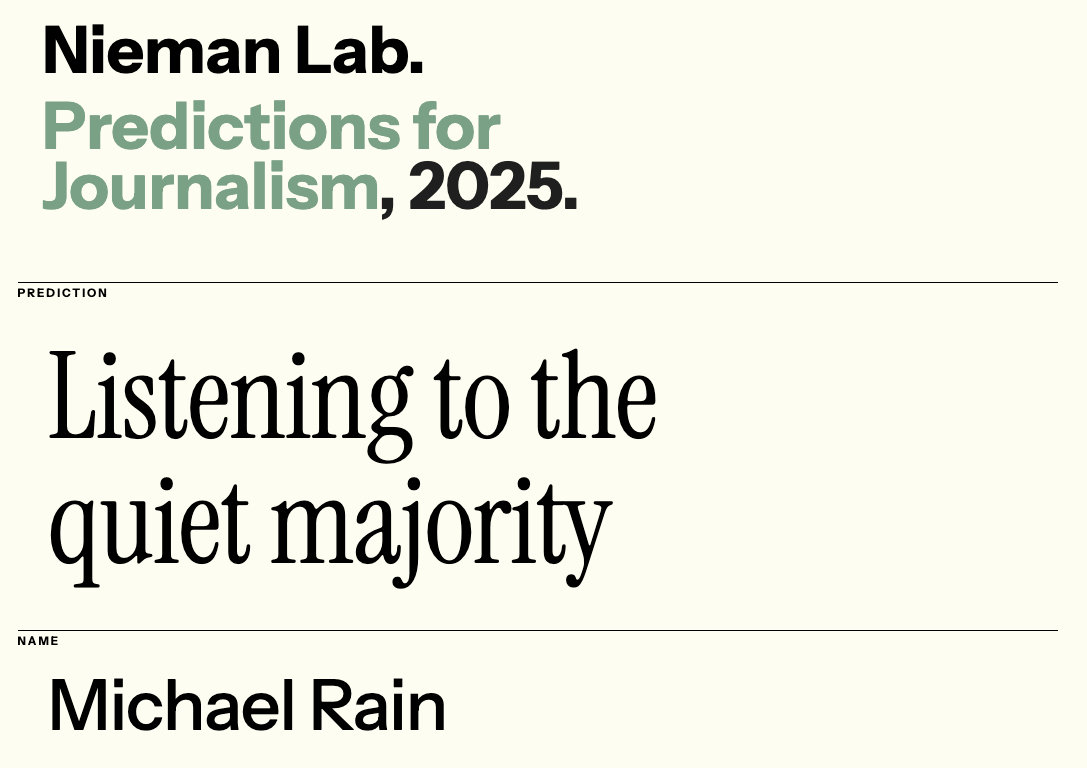
Nieman Journalism Lab
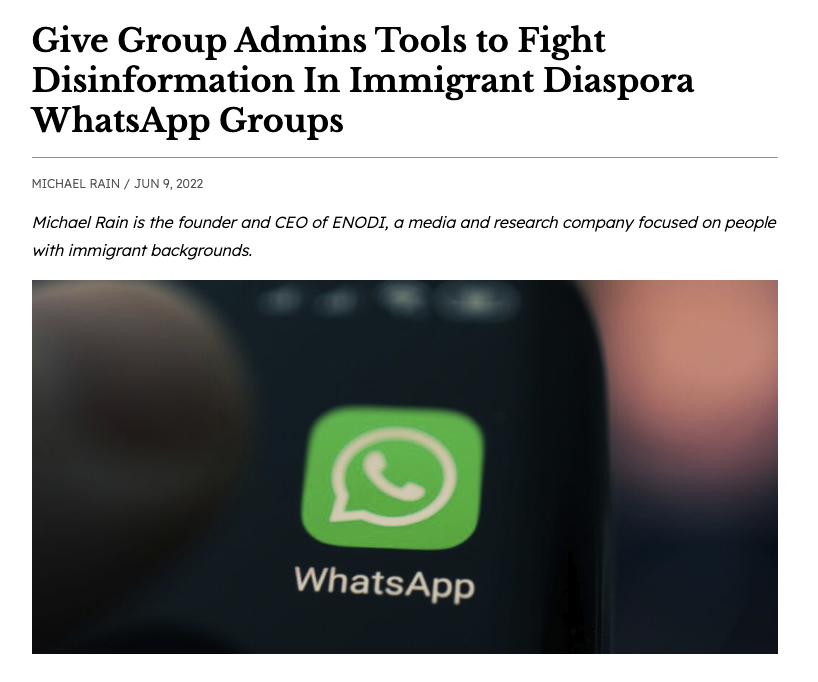
Tech Policy Press
Support that makes
this possible
The insights on this page aren't just theoretical—they are applied. From influencing global policy features at Meta to mapping the hidden "trust spaces" of the quiet majority, my work is designed to solve real-world problems where technology and human culture collide.
To maintain the independence and agility required to stay ahead of these shifts, I rely on the support of visionary funders and partners. I have has a successful period of fellowship-backed research at Harvard, Stanford, The Aspen Institute, and TED. I am looking for the next group of funders and collaborators to help scale these insights.
If my research resonates with your mission, I invite you to reach out. Whether you are looking to fund the next phase of this work, seeking a consultation to sharpen your organization’s engagement strategy, or interested in a collaborative research partnership, let’s build a more nuanced digital future together.
How we can work together:
Funding & Grants: Direct support for independent, applied research on PDMNs and digital culture.
Consultancy: Expert insights for institutions struggling with outreach, utility, and community trust.
Media & Speaking: Interviews, long-form writing, or keynote talks on the discourse and digital culture.
Meaningful Collaboration: Joint projects that move the needle on how we understand and build for marginalized communities.